Joint Species Distribution Modelling (JSDM)
Modelling multiple species simultaneously to capture ecological co-occurrence patterns and species interactions.
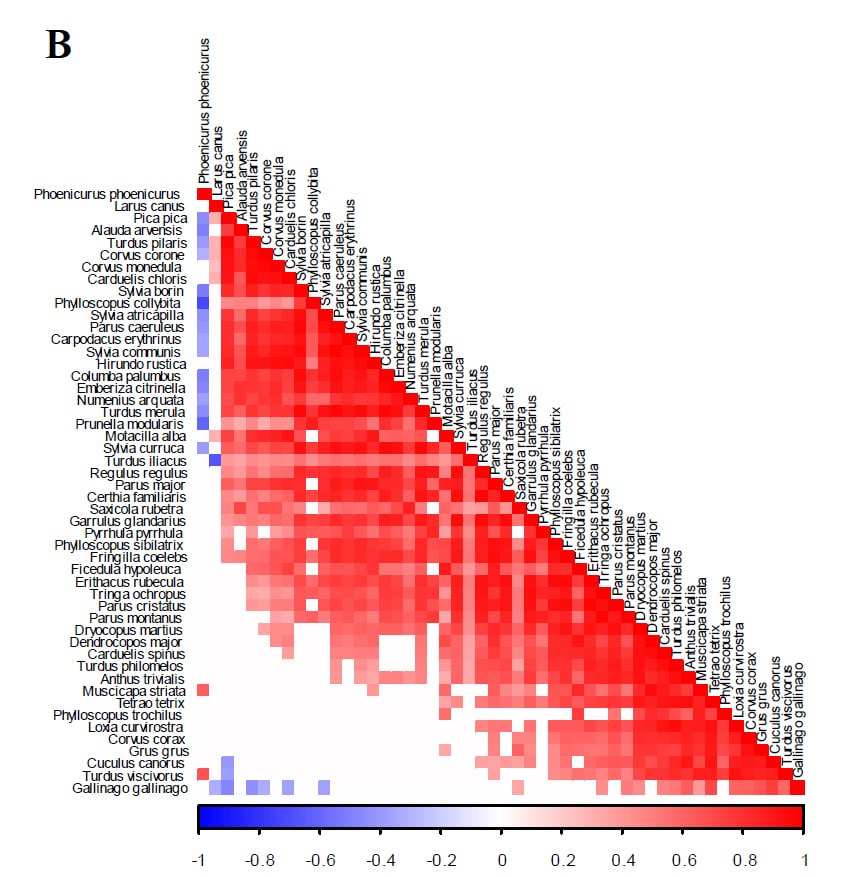
Residual correlation matrix among species derived from a joint species distribution model. Red indicates positive co-occurrence; blue indicates negative co-occurrence.
References
- Boulangeat, I., Philippe, P., Abdulhak, S., Douzet, R., Garraud, L., Lavergne, S., Lavorel, S., Van Es, J., Vittoz, P., & Thuiller, W. (2012). Improving plant functional groups for dynamic models of biodiversity: At the crossroads between functional and community ecology. Global Change Biology, 18(11), 3464–3475. https://doi.org/10.1111/j.1365-2486.2012.02783.x
- Doser, J. W., Finley, A. O., Banerjee, S. (2023). Joint species distribution models with imperfect detection for high-dimensional spatial data. Ecology, 104(9), e4137. https://doi.org/10.1002/ecy.4137
- Doser, J. W., Finley, A. O., Kéry, M., & Zipkin, E. F. (2022). spOccupancy: An R package for single-species, multi-species, and integrated spatial occupancy models. Methods in Ecology and Evolution, 13(8), 1670–1678. https://doi.org/10.1111/2041-210X.13897
- Hu, Y., Si-Moussi, S., & Thuiller, W. (2025). Introduction to deep learning methods for multi-species predictions. Methods in Ecology and Evolution, 16(1), 228–246. https://doi.org/10.1111/2041-210X.14466
- Khaliq, I., Hof, C., Prinzinger, R., Böhning-Gaese, K., & Pfenninger, M. (2014). Global variation in thermal tolerances and vulnerability of endotherms to climate change. Proceedings of the Royal Society B: Biological Sciences, 281(1789), 20141097. https://doi.org/10.1098/rspb.2014.1097
- Komatsu, K. J., Avolio, M. L., Padullés Cubino, J., Schrodt, F., Auge, H., Cavender-Bares, J., Clark, A. T., Flores-Moreno, H., Grman, E., Harpole, W. S., Kattge, J., Kimmel, K., Koerner, S. E., Korell, L., Langley, J. A., Münkemüller, T., Ohlert, T., Onstein, R. E., Roscher, C., Soudzilovskaia, N. A., Taylor, B. N., Tedersoo, L., Terry, R. S., & Wilcox, K. (2024). CoRRE Trait Data: A dataset of 17 categorical and continuous traits for 4079 grassland species worldwide. Scientific Data, 11, 795. https://doi.org/10.1038/s41597-024-03637-x
- Maitner, B. (2025). BIEN: Tools for accessing the Botanical Information and Ecology Network Database (R package version 1.2.7). CRAN.
- Maitner, B. S., Boyle, B., Casler, N., Condit, R., Donoghue, J., Duran, S. M., Guaderrama, D., Hinchliff, C. E., Jorgensen, P. M., Kraft, N. J. B., McGill, B., Merow, C., Morueta-Holme, N., Peet, R. K., Sandel, B., Schildhauer, M., Smith, S. A., Svenning, J.-C., Thiers, B., Violle, C., Wiser, S., & Enquist, B. J. (2018). The BIEN R package: A tool to access the Botanical Information and Ecology Network (BIEN) database. Methods in Ecology and Evolution, 9(2), 373–379. https://doi.org/10.1111/2041-210X.12861
- Ovaskainen, O., Tikhonov, G., Norberg, A., Blanchet, F. G., Duan, L., Dunson, D., Roslin, T., & Abrego, N. (2017). How to make more out of community data? A conceptual framework and its implementation as models and software. Ecology Letters, 20(5), 561–576. https://doi.org/10.1111/ele.12757
- Pollock, L. J., Tingley, R., Morris, W. K., Golding, N., O'Hara, R. B., Parris, K. M., Vesk, P. A., & McCarthy, M. A. (2014). Understanding co-occurrence by modelling species simultaneously with a joint species distribution model (JSDM). Methods in Ecology and Evolution, 5(5), 397–406. https://doi.org/10.1111/2041-210X.12180
- Tikhonov, G., Opedal, Ø. H., Abrego, N., Lehikoinen, A., de Jonge, M. M. J., Oksanen, J., & Ovaskainen, O. (2020). Joint species distribution modelling with the R-package Hmsc. Methods in Ecology and Evolution, 11(3), 442–447. https://doi.org/10.1111/2041-210X.13345
- Willis, S. G., Foden, W., Baker, D. J., Belle, E., Burgess, N. D., Carr, J. A., Doswald, N., Garcia, R. A., Hartley, A., Hof, C., Newbold, T., Rahbek, C., Smith, R. J., Visconti, P., Young, B. E., & Butchart, S. H. M. (2015). Integrating climate change vulnerability assessments from species distribution models and trait-based approaches. Biological Conservation, 190, 167–178. https://doi.org/10.1016/j.biocon.2015.05.001