Glossary
Definitions of plant traits and terminology used throughout Qplants.
Growth form
The general structural and morphological category of a plant, describing its overall architecture, size, and growth habit. Growth form reflects how plants adapt to environmental conditions, compete for resources, and occupy ecological niches.
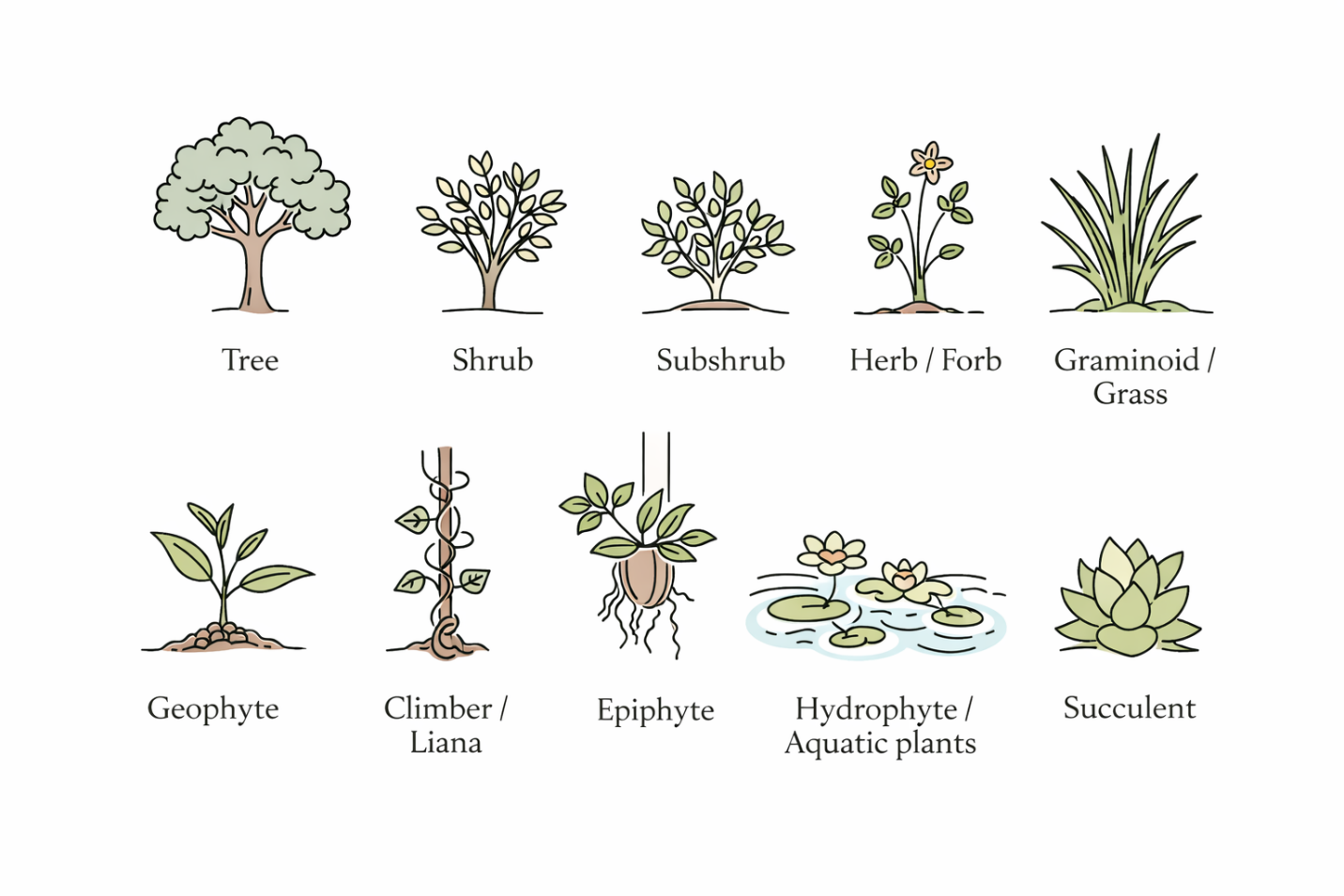
- Herb / Forb
- A non-woody flowering plant with soft, herbaceous stems, generally lacking persistent woody tissues and typically characterized by seasonal or short-lived aboveground growth.
- Herb
- A non-woody plant with soft, herbaceous stems and little or no persistent woody growth.
- Grass
- A herbaceous monocot with narrow leaves, typically hollow or jointed stems, and fibrous roots.
- Shrub
- A woody perennial plant, generally smaller than a tree, typically producing multiple stems from or near the base.
- Tree
- A tall, woody perennial plant with a persistent main stem or trunk, typically forming a distinct canopy.
- Shrub / Tree
- A woody perennial growth form with characteristics intermediate between shrubs and trees, ranging from multi-stemmed to single-trunked forms.
- Graminoid
- A grass-like herbaceous plant, including grasses, sedges, and rushes, typically characterized by narrow leaves and fibrous or tufted growth.
- Shrub / Subshrub
- A low-growing woody perennial with persistent woody stems near the base and relatively softer or herbaceous upper growth.
- Climber / Liana
- A plant with weak or flexible stems that uses external support to ascend or spread, including woody lianas and herbaceous climbers, thereby accessing light without developing extensive self-supporting structures.
- Succulent
- A plant with thickened, fleshy tissues specialized for water storage, typically adapted to arid, semi-arid, or seasonally dry environments.
Life form
The ecological and structural strategy of a plant based on the position of its perennating buds and survival organs during unfavourable environmental conditions, reflecting adaptation to climate, disturbance, and seasonality.
- Therophyte
- Annual plants surviving as seeds
- Hemicryptophyte
- Perennial plants with ground-level buds
- Chamaephyte
- Low-growing plants with aerial buds
- Phanerophyte
- Trees and shrubs with high buds
- Cryptophyte
- Perennial plants with underground or submerged buds
Lifespan
The length of time a plant lives from germination to death, classified as annual, biennial, or perennial.
- Annual
- Completes its entire life cycle (germination to seed production) within one year, then dies.
- Perennial
- Lives for multiple years, growing and reproducing repeatedly over many seasons.
- Biennial
- Completes its life cycle over two years, typically growing vegetatively in the first year and flowering in the second.
Plant height
The maximum vertical size attained by a plant during its growth reflects its competitive ability, resource acquisition strategy, and adaptation to environmental conditions.
Photosynthetic pathway
The biochemical strategy a plant uses to fix carbon during photosynthesis, reflecting adaptation to different temperature and water conditions.
- C3
- The most common pathway, efficient under cool, moist conditions but less efficient in hot or dry environments.
- C4
- An adaptation to high light, high temperature, and low CO₂, allowing more efficient photosynthesis with reduced water loss.
- CAM
- A water-saving pathway in which stomata open at night to fix CO₂, adapted to very arid conditions.
Leaf shape
The overall geometric form or outline of a leaf, reflecting structural adaptations related to light capture, water balance, and environmental conditions.
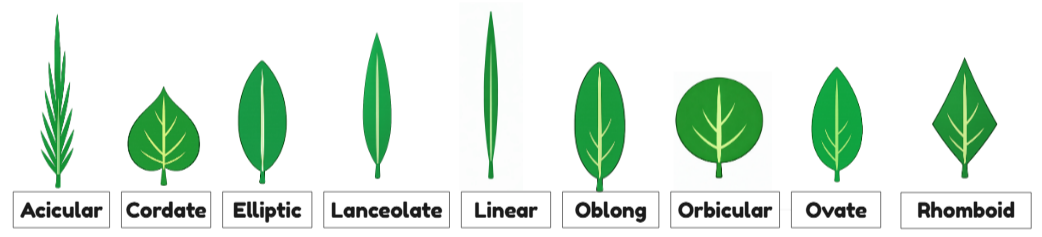
- Elliptic
- Oval-shaped leaves that are widest at the middle and taper evenly toward both ends.
- Oblong
- Leaves with parallel or nearly parallel sides and a length greater than the width.
- Linear
- Very narrow leaves with nearly parallel sides along their entire length.
- Orbicular
- Circular or nearly round leaves with a broad symmetrical outline.
- Ovate
- Egg-shaped leaves that are broader near the base and narrower toward the tip.
- Cordate
- Heart-shaped leaves with a broad base and a notch where the petiole attaches.
- Obovate
- Egg-shaped leaves that are broader toward the tip and narrower toward the base.
- Scale
- Small, thin, often overlapping leaves that are typically reduced and scale-like.
- Lanceolate
- Lance-shaped leaves that are longer than wide and taper gradually toward the tip.
- Spathulate
- Spoon-shaped leaves that are broader toward the tip and gradually narrow toward the base.
- Lanceolate / Ovate
- Leaves intermediate between lanceolate and ovate shapes, broader toward the base and gradually tapering toward the tip.
- Rhomboid
- Diamond-shaped leaves with angled sides and a broad central region.
Leaf area (petiole excluded)
The surface area of the leaf blade, excluding the petiole, reflects the photosynthetic capacity and resource-use strategy of the plant.
In terms of functionality, leaf area without the petiole is closely linked to photosynthetic capacity, growth potential, and overall plant productivity, as it reflects the surface available for carbon fixation without the confounding influence of structural support tissues (Niinemets et al., 2006).
Niinemets, Ü., Portsmuth, A., & Tobias, M. (2006). Leaf size modifies support biomass distribution among stems, petioles and mid‐ribs in temperate plants. New Phytologist, 171(1), 91–104. https://doi.org/10.1111/j.1469-8137.2006.01741.x
Leaf margin
Leaf margin type describes the form of the leaf edge, ranging from smooth (entire) to toothed or crenate. From an ecological perspective, variation in leaf margins reflects differences in how leaves interact with their environment, including water flow, light exposure, and physical stress (Givnish & Kriebel, 2017).
Leaf margin type is increasingly included in trait-based ecological analyses and vegetation models as a qualitative indicator of functional differences among species and as a potential correlate of species distributions along environmental gradients (Kattge et al., 2020; Wang et al., 2022).
The shape or pattern of the leaf edge.
- Entire
- Smooth edge with no teeth or indentations.
- Crenate
- Rounded edge with shallow, smooth teeth or scallops.
- Dentate
- Toothed edge with teeth pointing outward (perpendicular to the margin).

Givnish, T. J., & Kriebel, R. (2017). Causes of ecological gradients in leaf margin entirety: Evaluating the roles of biomechanics, hydraulics, vein geometry, and bud packing. American Journal of Botany, 104(3), 354–366. https://doi.org/10.3732/AJB.1600287
Kattge, J., Bönisch, G., Díaz, S., Lavorel, S., Prentice, I. C., Leadley, P., Tautenhahn, S., Werner, G. D., Aakala, T., Abedi, M., & Acosta, A. T. (2020). TRY plant trait database-enhanced coverage and open access. Global Change Biology, 26(1), 119–188. https://doi.org/10.1111/gcb.14904
Wang, H., Wang, R., Harrison, S. P., & Prentice, I. C. (2022). Leaf morphological traits as adaptations to multiple climate gradients. Journal of Ecology, 110(6), 1344–1355. https://doi.org/10.1111/1365-2745.13873
Leaf compoundness
The structural organization of a leaf is based on whether it consists of a single undivided blade or multiple distinct leaflets attached to a common axis.
- Simple
- One leaf, not divided
- Compound
- Leaf divided into many leaflets
- Compound (Pinnate)
- A compound leaf with leaflets arranged along a central axis; includes several forms such as tripinnate and bipinnate.
Across plant groups, whether leaves occur as single blades or are divided into multiple leaflets reflects different ways plants respond to physical stress, resource availability, and disturbance (Givnish, 1979; Nicotra et al., 2011). In compound leaves, the photosynthetic surface is split into smaller leaflets attached to a shared stalk, whereas simple leaves form a single continuous blade, a distinction that defines leaf compoundness as a basic structural trait in functional ecology (Lebrija-Trejos et al., 2010).
Givnish, T. (1979). On the adaptive significance of leaf form. Topics in Plant Population Biology, 375–407. https://doi.org/10.1007/978-1-349-04627-0_17
Nicotra, A. B., Leigh, A., Boyce, C. K., Jones, C. S., Niklas, K. J., Royer, D. L., & Tsukaya, H. (2011). The evolution and functional significance of leaf shape in the angiosperms. Functional Plant Biology, 38(7), 535–552. https://doi.org/10.1071/FP11057
Lebrija-Trejos, E., Pérez-García, E. A., Meave, J. A., Bongers, F., & Poorter, L. (2010b). Functional traits and environmental filtering drive community assembly in a species‐rich tropical system. Ecology, 91(2), 386–398. https://doi.org/10.1890/08-1449.1
Leaf thickness
Leaf thickness represents a central axis of variation in how plants balance carbon gain with resistance to environmental stress, capturing differences in internal leaf construction that are not evident from leaf area or mass alone (Aneja et al., 2025; Niinemets, 1998; Simonin et al., 2012).
Aneja, P., Sanyal, R., & Ranjan, A. (2025). Leaf growth in third dimension: a perspective of leaf thickness from genetic regulation to ecophysiology. New Phytologist, 245(3), 989–999. https://doi.org/10.1111/NPH.20246
Niinemets, U. (1998). Are compound-leaved woody species inherently shade-intolerant? An analysis of species ecological requirements and foliar support costs. Plant Ecology, 134(1), 1–11. https://doi.org/10.1023/A:1009773704558
Simonin, K.A., Limm, E.B. and Dawson, T.E. (2012), Hydraulic conductance of leaves correlates with leaf lifespan: implications for lifetime carbon gain. New Phytologist, 193: 939-947. https://doi.org/10.1111/j.1469-8137.2011.04014.x
Leaf nitrogen
The concentration of nitrogen within leaf tissues reflects photosynthetic capacity, growth rate, and nutrient-use strategy of the plant.
Leaf phenology
The seasonal pattern of leaf production, retention, and shedding in plants reflects adaptation to climatic and environmental conditions.
- Evergreen
- Keeps leaves all year
- Deciduous
- Loses leaves seasonally
Leaf length
Leaf length is a morphological trait defined as the maximum linear distance from the leaf apex to its base at the junction of the blade and petiole, typically measured along the midrib in simple leaves or along the longest axis in compound leaves (Schrader et al., 2021). Ecologically, leaf length represents a component of overall leaf size and is often used as a proxy for light capture potential and boundary layer characteristics, which influence gas exchange and energy balance at the leaf surface (Wright et al., 2004).
Schrader, J., Shi, P., Royer, D. L., Peppe, D. J., Gallagher, R. V., Li, Y., Wang, R., & Wright, I. J. (2021). Leaf size estimation based on leaf length, width and shape. Annals of Botany, 128(4), 395–406. https://doi.org/10.1093/AOB/MCAB078
Wright, I. J., Reich, P. B., Westoby, M., Ackerly, D. D., Baruch, Z., Bongers, F., Cavender-Bares, J., Chapin, T., Cornelissen, J. H. C., Diemer, M., Flexas, J., Garnier, E., Groom, P. K., Gulias, J., Hikosaka, K., Lamont, B. B., Lee, T., Lee, W., Lusk, C., … Villar, R. (2004). The worldwide leaf economics spectrum. Nature, 428(6985), 821–827.
Fruit type
The structural form of a mature fruit, based on how it develops and releases seeds.
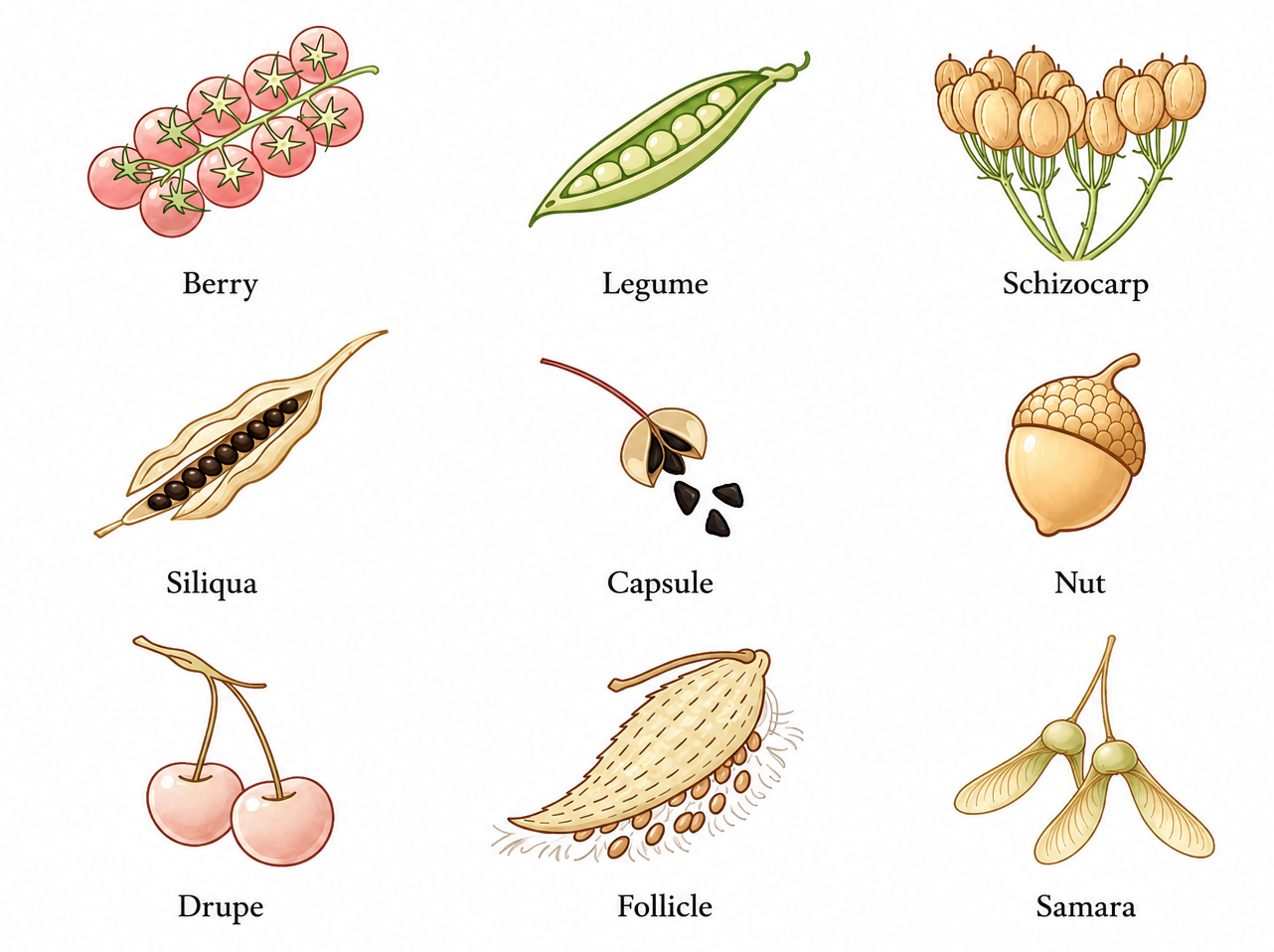
- Capsule
- A dry fruit that splits open at maturity to release seeds.
- Berry
- A fleshy fruit with seeds embedded in the pulp.
- Drupe
- A fleshy fruit with a single hard stone enclosing the seed (e.g., peach-like).
- Achene
- A small, dry, one-seeded fruit that does not open at maturity.
- Nut
- A hard, dry, one-seeded fruit with a thick woody wall.
- Follicle
- A dry fruit that splits along one side to release seeds.
- Pod
- A dry fruit that splits along two sides at maturity to release seeds.
- Siliqua
- A long, narrow dry fruit that splits into two valves, with seeds attached to a central partition.
- Loment
- A dry, segmented fruit that breaks into one-seeded sections at maturity.
- Samara
- A dry, one-seeded fruit with a wing-like structure that aids wind dispersal.
- Utricle
- A small, dry, thin-walled fruit that usually contains a single seed and is loosely enclosed by the fruit wall.
- Dry
- A fruit with a dry, non-fleshy pericarp at maturity.
Dispersal syndrome
The primary mechanism by which a plant's seeds or fruits are dispersed, reflecting adaptations for movement through agents:
- Animal
- Seeds dispersed by animals.
- Gravity / Self
- Seeds dispersed by falling or spreading naturally near the parent plant.
- Wind
- Seeds dispersed by air movement.
- Water
- Seeds dispersed by water flow.
- Human
- Seeds dispersed intentionally or unintentionally by human activities.
- Explosive (Ballistic)
- Seeds dispersed by the explosive opening of the fruit.
- Ant
- Seeds dispersed by ants through collection and transport.
- Animal (Cached / Hoarded)
- Seeds dispersed when animals collect and store them, with some remaining to germinate.
- Rain
- Seeds dispersed by the impact or flow of rainwater.
Dispersal unit type
Describes the characteristics of a plant's dispersal unit, including its seed number, reproductive origin, and the type of structure dispersed.
Seed Number
Indicates the number of seeds contained in the dispersal unit.
- One-seeded
- A dispersal unit containing a single seed.
- Multi-seeded
- A dispersal unit containing more than one seed.
Origin
Indicates the reproductive origin of the dispersal unit.
- Generative
- A dispersal unit produced through sexual reproduction.
- Vegetative
- A dispersal unit produced from vegetative plant parts rather than seeds.
Unit Type
Identifies the plant structure that functions as the dispersal unit.
- Seed
- A mature ovule containing an embryo that can develop into a new plant.
- Fruit
- A mature reproductive structure containing one or more seeds.
- Fruit with Appendage
- A fruit with structures such as wings, hooks, or hairs that aid dispersal.
- Fruitlet
- A small individual fruit that forms part of a larger fruit or fruiting structure.
- Germinule
- A small vegetative propagule capable of developing into a new plant.
Seed oil content
The proportion of oil stored within seeds, reflecting energy reserves important for seed development, dispersal, and germination success.
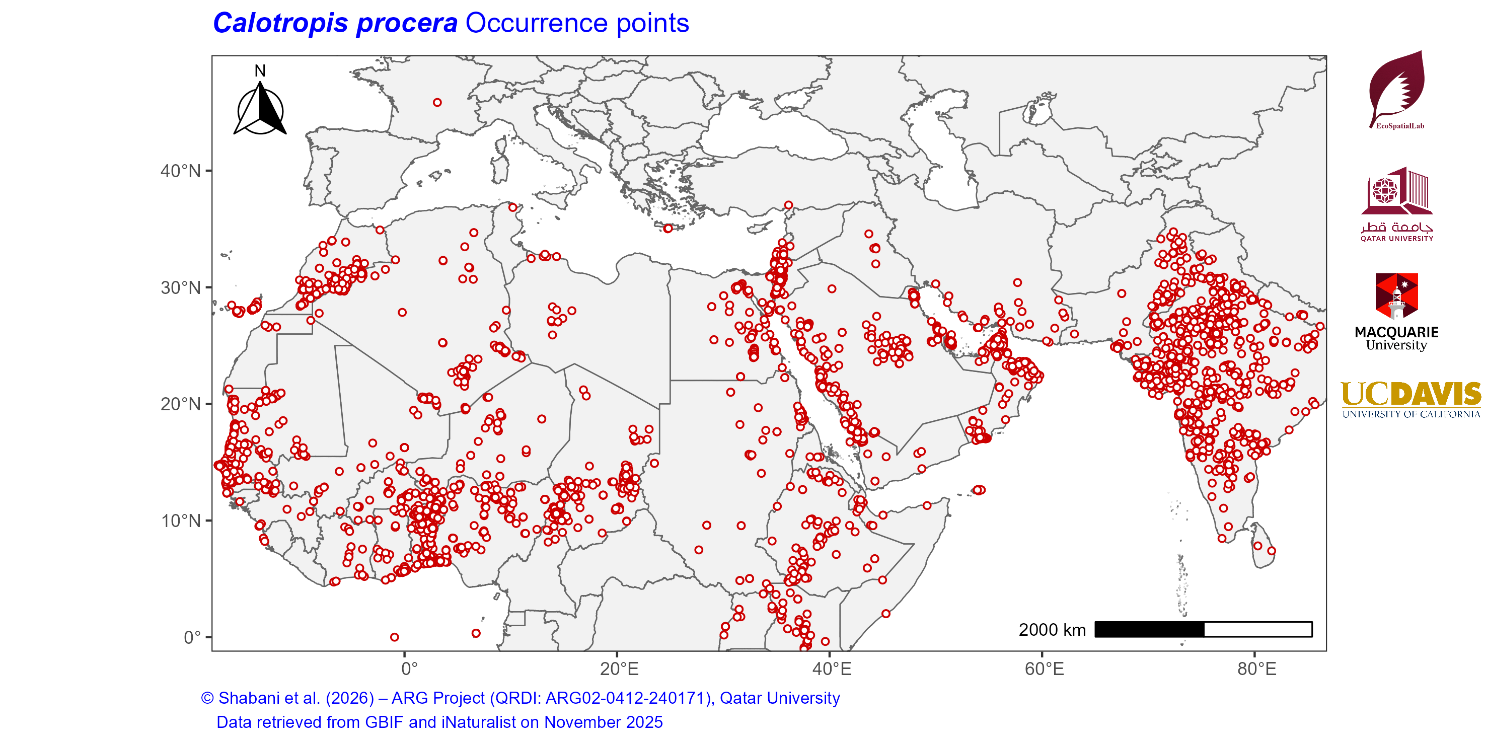
Occurrence
Red dots on this map represent the documented global occurrences of this species, based on records from the Global Biodiversity Information Facility (gbif.org) and/or iNaturalist
Bioclimatic variables
- BIO1
- Annual Mean Temperature
- BIO2
- Mean Diurnal Range (Mean of monthly (max temp - min temp))
- BIO3
- Isothermality (BIO2/BIO7) (×100)
- BIO4
- Temperature Seasonality (standard deviation ×100)
- BIO5
- Max Temperature of Warmest Month
- BIO6
- Min Temperature of Coldest Month
- BIO7
- Temperature Annual Range (BIO5-BIO6)
- BIO8
- Mean Temperature of Wettest Quarter
- BIO9
- Mean Temperature of Driest Quarter
- BIO10
- Mean Temperature of Warmest Quarter
- BIO11
- Mean Temperature of Coldest Quarter
- BIO12
- Annual Precipitation
- BIO13
- Precipitation of Wettest Month
- BIO14
- Precipitation of Driest Month
- BIO15
- Precipitation Seasonality (Coefficient of Variation)
- BIO16
- Precipitation of Wettest Quarter
- BIO17
- Precipitation of Driest Quarter
- BIO18
- Precipitation of Warmest Quarter
- BIO19
- Precipitation of Coldest Quarter
(https://www.worldclim.org/data/bioclim.html)